---
title: '1K, 1M, 1B: How Many Zeros? K/M/B/T Abbreviations and a Million, Billion, Trillion Conversion Chart'
url: https://joelin.cc/en/p/9349
source: https://joelin.cc/en/p/9349
lang: en
pubDate: '2026-10-27'
date_modified: '2026-10-27'
description: 1K is 1,000 (a thousand), 1M is 1,000,000 (a million), 1B is 1,000,000,000 (a billion). Charts for K/M/B/T, zero counts, kk, MM, bps and Chinese wan/yi.
schema_type: BlogPosting
author: joe
entity_ids:
author: https://me.joelin.cc/#joe
ai_role: ai_only
translation_assistant: caddy
ai_credit: 'AI-assisted translation and editing: Caddy (AI)'
faq:
- q: How many zeros are in a million, a billion and a trillion?
a: A thousand (1K) has 3 zeros, a million (1M) has 6, a billion (1B) has 9 and a trillion (1T) has 12. Each step up adds three zeros, because each unit is 1,000 times the one before it.
- q: Is 1,000K the same as 1M?
a: Yes. 1,000K is 1,000 × 1,000 = 1,000,000, which is one million (1M). In the same way, 1,000M is 1B and 1,000B is 1T.
- q: Are the K, M, G and T in KB, MB, GB and TB the same as the number abbreviations?
a: Not quite. In money and counts, K, M, B and T are plain numbers (K = 1,000, M = 1,000,000). KB, MB, GB and TB in computing measure bytes and have traditionally been counted in powers of 2 (1 KB = 1,024 bytes, 1 MB = 1,024 KB). The IEC standard uses KiB and MiB for multiples of 1,024 and keeps KB and MB for multiples of 1,000, but everyday usage still mixes the two. In short, K, M, B or T on its own is a number; once a "B" for byte follows it, as in KB or MB, it is an amount of data.
- q: Is M the same as m?
a: 'It depends on the case and the context. Capital M in money and finance means million: "$5M" is five million dollars. Lowercase m in science and engineering is the SI prefix milli, one thousandth (as in mm for millimeter), and m on its own is the meter. In headlines and social media, though, "$1m" or "1.8m" usually still means million; an m that follows an amount of money is almost always a million. Strictly speaking, million should be a capital M, but the mixed usage is so common that you read it from context.'
- q: What comes after a million?
a: 'English moves to a new word every three digits, and the words all end in -illion: million (10^6), billion (10^9), trillion (10^12), quadrillion (10^15), quintillion (10^18), sextillion (10^21), and so on up to vigintillion (10^63). The rule is that a Latin prefix for the number n gives 10^(3n+3): billion (bi = 2) is 10^9 and trillion (tri = 3) is 10^12. Bigger still are the googol, 10^100, and the googolplex, 10 to the power of a googol. The word googol was coined in 1920 by Milton Sirotta, the nine-year-old nephew of the mathematician Edward Kasner, and Kasner popularized it in a 1940 book.'
- q: Isn't a billion 10^12 in the UK?
a: 'Not in English today. The short scale (billion = 10^9, trillion = 10^12) is now standard in English. Earlier, Britain used the long scale, in which a billion was 10^12 and 10^9 was called a milliard. Some European languages, such as German, still use the long scale: Milliarde = 10^9, Billion = 10^12 ([Duden](https://www.duden.de/rechtschreibung/Billion)). Keep that difference in mind when you read older English documents or material in other European languages.'
- q: What are the SI prefixes?
a: 'Going up: kilo (k, 10^3), mega (M, 10^6), giga (G, 10^9), tera (T, 10^12), peta (P, 10^15), exa (E, 10^18). Going down: milli (m, 10^-3, one thousandth), micro (μ, 10^-6, one millionth), nano (n, 10^-9, one billionth), pico (p, 10^-12, one trillionth). Kilo to tera and milli to pico were formally adopted in 1960, when the International System of Units (SI) was established; peta and exa were added in 1975.'
- q: What is 1 yi (億) in English?
a: English has no single word for the Chinese 億. It is 100,000,000, written as one hundred million, or 100M. In the same way, 1 wan (萬) is ten thousand (10K), and 1 zhao (兆) is one trillion (1T).
translation_of: /p/9349
mentions:
- name: United States dollar
sameAs:
- https://www.wikidata.org/wiki/Q4917
- name: SI prefix
sameAs:
- https://www.wikidata.org/wiki/Q131299
---
# 1K, 1M, 1B: How Many Zeros? K/M/B/T Abbreviations and a Million, Billion, Trillion Conversion Chart
The short answer: 1K = 1,000 (one thousand), 1M = 1 million = 1,000,000, and 1B = 1 billion = 1,000,000,000. So 100K is 100,000 (one hundred thousand), and 10M is 10,000,000 (ten million).
If you ran into these abbreviations on an AI price list, see also [what a token is and how AI billing works](/en/p/9770).
| Abbreviation | Spelled
out | Number | Zeros | In US
dollars |
| --- | --- | --- | --- | --- |
| 1K | one thousand | 1,000 | 3 | $1K = $1,000 |
| 1M | one million | 1,000,000 | 6 | $1M = $1,000,000 |
| 1B | one billion | 1,000,000,000 | 9 | $1B = $1,000,000,000 |
| 1T | one trillion | 1,000,000,000,000 | 12 | $1T = $1,000,000,000,000 |
Each letter is 1,000 times the one before it, which is why every step adds exactly three zeros. The letters only tell you the size of the number, not the currency: USD 1M is one million US dollars, while RM1M is one million Malaysian ringgit and TWD 1M is one million New Taiwan dollars.
English moves to a new unit every three digits (thousand, million, billion), while Chinese moves every four digits (wan, yi, zhao). This page covers the conversion charts, quick reverse lookups, the common mix-ups and the finance shorthand in one place.
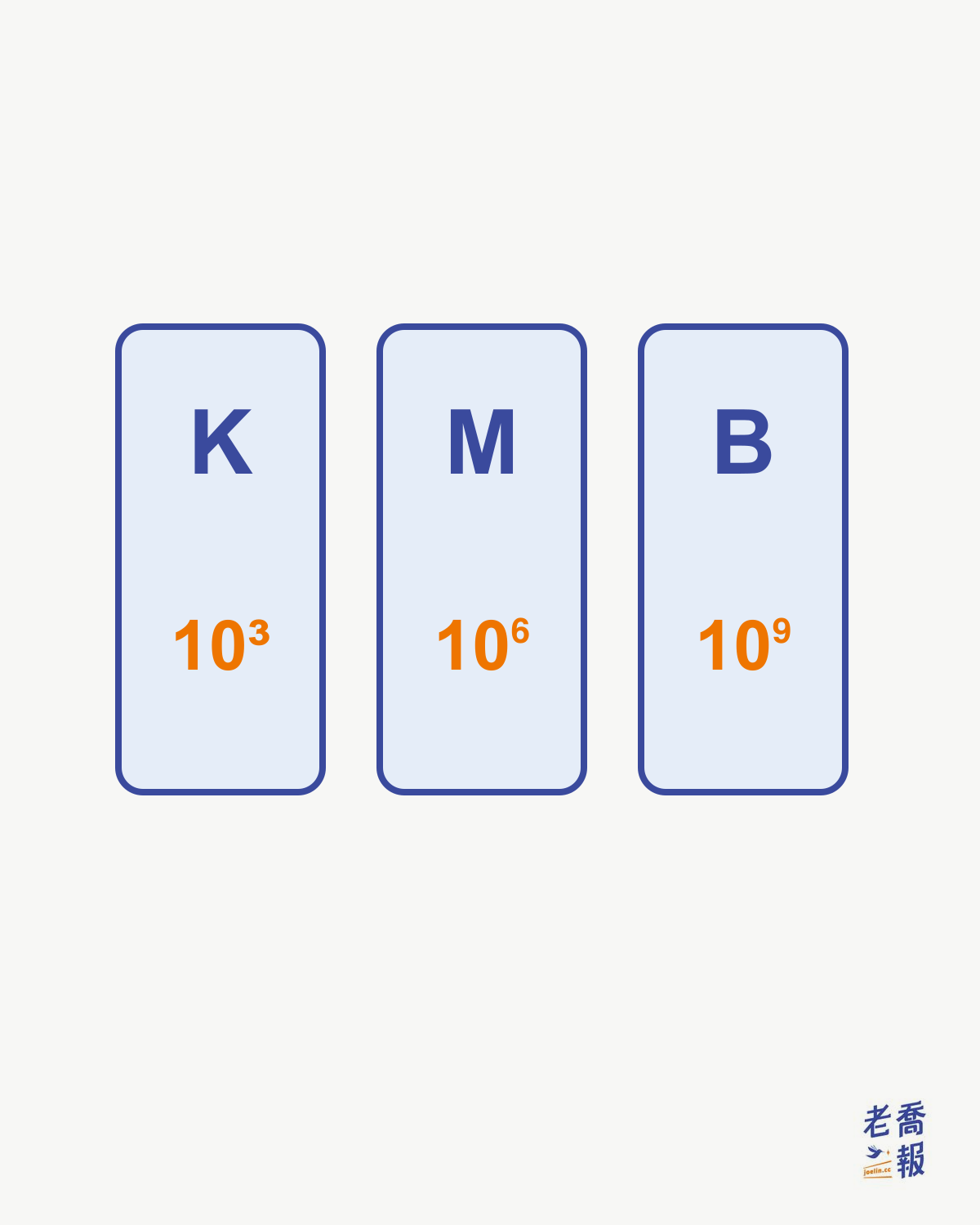
*Illustration by joelin.cc. A schematic diagram for explanation.*
## Number abbreviation chart: amounts to K, M, B and T
This is the table most people need:
| Amount | Number | Abbreviation | Read as |
| --- | --- | --- | --- |
| one thousand | 1,000 | 1K | one thousand |
| ten thousand | 10,000 | 10K | ten thousand |
| fifty thousand | 50,000 | 50K | fifty thousand |
| one hundred thousand | 100,000 | 100K | one hundred thousand |
| two hundred thousand | 200,000 | 200K | two hundred thousand |
| three hundred thousand | 300,000 | 300K | three hundred thousand |
| five hundred thousand | 500,000 | 500K | five hundred thousand |
| one million | 1,000,000 | 1M | one million |
| five million | 5,000,000 | 5M | five million |
| ten million | 10,000,000 | 10M | ten million |
| one hundred million | 100,000,000 | 100M | one hundred million |
| one billion | 1,000,000,000 | 1B | one billion |
| ten billion | 10,000,000,000 | 10B | ten billion |
| one hundred billion | 100,000,000,000 | 100B | one hundred billion |
| one trillion | 1,000,000,000,000 | 1T | one trillion |
The pattern is simple: the letter changes every time you add three zeros. English has no single word for ten thousand or one hundred million, so those amounts are written as combinations such as 10K and 100M.
## What do 1K, 1M, 1B and 1T mean, and how much are they?
### How much is 1K?
1K = 1 thousand = 1,000. A monthly salary of 100K is 100,000 a month; 10K is ten thousand and 100K is one hundred thousand.
### How much is 1M?
1M = 1 million = 1,000,000. An annual salary of 1M is a million a year, and $1.8M is 1.8 million dollars, or $1,800,000.
### How much is 1B?
1B = 1 billion = 1,000,000,000. A news headline about a company "raising $1B" means it raised one billion US dollars.
### How much is 1T?
1T = 1 trillion = 1,000,000,000,000. When a US tech giant has a market value of 3T, that is three trillion dollars.
## What do K, M, B and T stand for?
### What is K?
K stands for thousand, so 1K = 1,000. In money, 1K is a thousand dollars, pounds or whatever currency follows.
### What is M?
M stands for million, so 1M = 1,000,000. In money, 1M is a million of the currency in question.
### What is B?
B stands for billion, so 1B = 1,000,000,000, which is 1,000 millions.
### What is T?
T stands for trillion, so 1T = 1,000,000,000,000, which is 1,000 billions.
(If you see NT, that is not a number unit. It is the New Taiwan dollar, as in NT$1,500.)
These abbreviations come from the English number words, and they line up with the SI prefixes used in science:
| Abbreviation | Full
name | Value | Power
of 10 |
| --- | --- | --- | --- |
| K | thousand (kilo) | 1,000 | 10^3 |
| M | million (mega) | 1,000,000 | 10^6 |
| B | billion (G, giga, in engineering) | 1,000,000,000 | 10^9 |
| T | trillion (tera) | 1,000,000,000,000 | 10^12 |
Finance and everyday writing use K, M, B and T, while science and engineering write the same magnitudes as the SI prefixes k, M, G and T. When a currency follows the amount, you get forms like "500K USD" (five hundred thousand US dollars) or "5M USD" (five million US dollars).
If you need the Indian units lakh and crore, they have their own guide: [Lakh and Crore to Million and Billion](/en/p/200024).
## The mix-ups that trip people up
### K or M: which is bigger?
M is bigger, by a factor of 1,000. 1M = 1,000K, so 2,500K is 2.5M and 0.5M is 500K. Likewise 1B = 1,000M and 1T = 1,000B.
One trap comes from accounting, where M can mean thousand and MM means million (see the MM section below). In everyday finance and on social media, though, M is a million.
### Isn't a billion 10^12 in the UK?
In English today the short scale is standard: a billion is 10^9 and a trillion is 10^12. Earlier, Britain used the long scale, in which a billion was 10^12 and 10^9 was called a milliard. Some European languages, such as German, still use the long scale: Milliarde = 10^9, Billion = 10^12 ([Duden](https://www.duden.de/rechtschreibung/Billion)). When you read older English documents or material in other European languages, check which scale is meant.
### Converting Chinese 萬, 億 and 兆
Chinese counts in steps of four digits, so their units fall between the English ones. The wan (萬) is 10,000 and the yi (億) is 100,000,000; neither has a single English word, so both are written as combinations:
| Chinese
unit | Value | English | Abbreviation |
| --- | --- | --- | --- |
| 千 (qian) | 10^3 | one thousand | 1K |
| 萬 (wan) | 10^4 | ten thousand | 10K |
| 十萬 | 10^5 | one hundred thousand | 100K |
| 百萬 | 10^6 | one million | 1M |
| 千萬 | 10^7 | ten million | 10M |
| 億 (yi) | 10^8 | one hundred million | 100M |
| 十億 | 10^9 | one billion | 1B |
| 百億 | 10^10 | ten billion | 10B |
| 兆 (zhao) | 10^12 | one trillion | 1T |
| 京 (jing) | 10^16 | ten quadrillion | none |
| 垓 (gai) | 10^20 | one hundred quintillion | none |
Each Chinese unit is 10,000 times the one below it, while each English word is 1,000 times the one below it. So the wan and the yi always land between two English units, and 兆 happens to match trillion exactly.
A few more forms you may meet:
- In mainland China, 10^12 is usually written 万亿 (萬億 in traditional characters, wanyi) instead of 兆, because 兆 is used for a million (10^6) in everyday contexts such as broadband speeds and 兆赫 (MHz). So 1 萬億 = 1 兆 = 1T, and "GDP passes 130 萬億 yuan" means 130 trillion yuan (130T).
- 一億萬 (one yi wan) is 1 億 × 1 萬 = 10^12, the same as 1 兆 or 1T. It is not a formal way to write the number, and 億萬 in everyday speech, as in 億萬富翁 (billionaire), just means a very large amount.
- 億億 is 1 億 × 1 億 = 10^16, which is 1 京 (ten quadrillion).
Numbers built on 4 show how the English wording shifts as the Chinese unit grows:
| Chinese
amount | Number | English | Abbreviation |
| --- | --- | --- | --- |
| 4 萬 | 40,000 | forty thousand | 40K |
| 40 萬 | 400,000 | four hundred thousand | 400K |
| 400 萬 | 4,000,000 | four million | 4M |
| 4,000 萬 | 40,000,000 | forty million | 40M |
| 4 億 | 400,000,000 | four hundred million | 400M |
The same 4 becomes 40K, then 400K, then switches to M at the million level for 4M, then 40M and 400M. Note the spelling forty, not fourty.
## Reverse lookup: how much is 1,000K, 1 million or 1 billion?
### How many zeros?
| Unit | Number | Zeros |
| --- | --- | --- |
| thousand | 1,000 | 3 |
| million | 1,000,000 | 6 |
| billion | 1,000,000,000 | 9 |
| trillion | 1,000,000,000,000 | 12 |
| quadrillion | 1,000,000,000,000,000 | 15 |
| quintillion | 1,000,000,000,000,000,000 | 18 |
Every English unit is 1,000 times the previous one: 1M = 1,000K, 1B = 1,000M and 1T = 1,000B. So 1 billion is 1,000 millions, and 0.5B is 500M.
- A million is 1,000,000 (10^6), abbreviated 1M.
- A billion is 1,000,000,000 (10^9), abbreviated 1B, or 1,000 millions.
- A trillion is 1,000,000,000,000 (10^12), abbreviated 1T, or 1,000 billions.
- A thousand is 1,000 (10^3), abbreviated 1K.
News stories often spell numbers out (one billion, ten million). Here is how the spellings match the abbreviations:
| Spelled
out | Abbreviation | Number |
| --- | --- | --- |
| one thousand | 1K | 1,000 |
| ten thousand | 10K | 10,000 |
| one million | 1M | 1,000,000 |
| ten million | 10M | 10,000,000 |
| one hundred million | 100M | 100,000,000 |
| one billion | 1B | 1,000,000,000 |
| ten billion | 10B | 10,000,000,000 |
| one trillion | 1T | 1,000,000,000,000 |
| 1,000K | 1M | 1,000,000 |
| one quadrillion | none | 10^15 |
Million, billion and trillion each sit 1,000 times apart, so every jump from one word to the next multiplies the amount by 1,000.
### How much is N million or N billion?
Multiply: N million = N × 1,000,000, and N billion = N × 1,000,000,000.
| English | Number |
| --- | --- |
| 1 million | 1,000,000 |
| 5 million | 5,000,000 |
| 8 million | 8,000,000 |
| 10 million | 10,000,000 |
| 17 million | 17,000,000 |
| 20 million | 20,000,000 |
| 30 million | 30,000,000 |
| 50 million | 50,000,000 |
| 100 million | 100,000,000 |
| 500 million | 500,000,000 |
| 1 billion | 1,000,000,000 |
| 10 billion | 10,000,000,000 |
For a currency conversion, apply the exchange rate after you have the full number.
### How much is 10K, 100K or 500K?
K means thousand, so multiply the number in front by 1,000.
| Written | Spelled out | Number |
| --- | --- | --- |
| 1K | one thousand | 1,000 |
| 10K | ten thousand | 10,000 |
| 20K | twenty thousand | 20,000 |
| 50K | fifty thousand | 50,000 |
| 60K | sixty thousand | 60,000 |
| 100K | one hundred thousand | 100,000 |
| 120K | one hundred twenty thousand | 120,000 |
| 200K | two hundred thousand | 200,000 |
| 300K | three hundred thousand | 300,000 |
| 400K | four hundred thousand | 400,000 |
| 500K | five hundred thousand | 500,000 |
| 1,000K | one million | 1,000,000 |
To read a K amount out loud, you can also just say the letter: 500K is often spoken as five hundred K.
### How much is 1M, 10M or 100M?
M means million, so multiply the number in front by 1,000,000.
| Written | Spelled out | Number |
| --- | --- | --- |
| 1M | one million | 1,000,000 |
| 1.5M | one and a half million | 1,500,000 |
| 2M | two million | 2,000,000 |
| 2.5M | two and a half million | 2,500,000 |
| 5M | five million | 5,000,000 |
| 10M | ten million | 10,000,000 |
| 20M | twenty million | 20,000,000 |
| 50M | fifty million | 50,000,000 |
| 100M | one hundred million | 100,000,000 |
Decimals work the same way, with no need to convert to whole numbers first: 1.2M = 1,200,000, 1.8M = 1,800,000 and 1.1K = 1,100. The rule is the same for K, M, B and T.
### How much is 1B or 1T?
| Written | Spelled out | Number |
| --- | --- | --- |
| 1B | one billion | 1,000,000,000 |
| 10B | ten billion | 10,000,000,000 |
| 1T | one trillion | 1,000,000,000,000 |
In Chinese terms, 1B is 10 億 and 1T is 10,000 億, or 1 兆.
## Abbreviations for quantities, units and amounts (quotes, orders and Excel)
K, M and B are just numbers, so they work with anything: after money they are amounts, after items they are quantities.
### Units for quantities
The most common quantity abbreviations are pcs (pieces), Qty (quantity), set, box, ctn (carton) and doz (dozen). For the size of a quantity, you go back to K and M: 10K pcs is 10,000 pieces. The full column list is in the table below.
### How much is 1K or 1M as a count?
- 1K = 1,000 (10K followers = 10,000 people)
- 1M = 1,000,000 (1.2M YouTube views = 1,200,000 views)
- 1B = 1,000,000,000 (a world population of 8B = 8 billion people)
The arithmetic is exactly the same as for money; only the unit changes from dollars to items, people or views. When a dashboard shows 1.5K or 23.4M, read it with the same table.
### Common column abbreviations on quotes, orders and spreadsheets
When you build a table, the sticking point is usually the column names rather than the numbers. These are the standard forms:
| Column | Full
English | Common
abbreviation | Notes |
| --- | --- | --- | --- |
| Quantity | quantity | Qty (also QTY, Q'ty) | The most common column on orders and quotes |
| Pieces | pieces | pcs (singular pc) | "10 pcs" = 10 pieces |
| Unit | unit of measure | U/M, UOM | The pricing unit itself (piece, box, kilogram) |
| Unit price | unit price | U/P | Often written out as Unit Price |
| Amount | amount | Amt. | |
| Subtotal | subtotal | Sub-total | Line total before tax and shipping |
| Total, grand total | total / grand total | Total, G/T | See the notes below |
| Number | number | No. | From the Latin numero, so No. rather than Nu. |
| Each | each | ea. | "$50 ea." = $50 per item |
| Not applicable | not applicable | N/A | |
| Discount | discount | Disc. | |
| Excluding / including tax | excluding / including tax | Excl. tax / Incl. tax | |
| Minimum order quantity | minimum order quantity | MOQ | Standard on export quotes |
| Purchase order | purchase order | PO | |
| Carton | carton | Ctn | |
| Dozen (12 items) | dozen | Doz. | |
The @ you often see in these tables means "at a unit price of": `10 pcs @ $50 = $500` reads as ten pieces at fifty dollars each.
### How do you abbreviate total and grand total?
The slightly counterintuitive answer is that Total is short enough already, so in practice it is usually left as Total.
- Sub-total: the sum of a group of line items
- Total: the sum of a section
- Grand Total (G/T or G.T.): the final line of the whole document, including tax and shipping
- If you must shorten Total, write Tot.; financial statements occasionally use Ttl, but it is not a standard form
So a quote reads from top to bottom as Qty × U/P → Amt. → Sub-total → Tax → Grand Total.
### Currency codes
The full form of an amount is number + magnitude + currency, and the currency is written with its three-letter ISO 4217 code:
| Currency | Code | Written with
a symbol |
| --- | --- | --- |
| US dollar | USD | US$50, $50 |
| New Taiwan dollar | TWD (banks and everyday use also write NTD) | NT$1,500 |
| Japanese yen | JPY | ¥10,000 |
| Chinese yuan (renminbi) | CNY (CNH for offshore quotes) | ¥ / RMB 1,000 |
| Euro | EUR | €100 |
| Hong Kong dollar | HKD | HK$500 |
Combined with the number abbreviations, this gives the standard financial-news format: 500K USD is five hundred thousand US dollars, and 5M TWD is five million New Taiwan dollars.
## What do kk, MM and bps mean?
### What does kk mean? How much is 10kk?
kk is K written twice, meaning a thousand thousands, which is a million: 1kk = 1,000 × 1,000 = 1,000,000 = 1M. So 10kk = 10 × 1,000,000 = 10,000,000 (10M).
| Written | How it
works | Number | Answer |
| --- | --- | --- | --- |
| 1kk | 1 × 1,000 × 1,000 | 1,000,000 | one million (1M) |
| 10kk | 10 × 1,000 × 1,000 | 10,000,000 | ten million (10M) |
| 1kkk | 1 × 1,000 × 1,000 × 1,000 | 1,000,000,000 | one billion (1B) |
The form is most common in trading in-game currency in online games, where many players write 1kk more often than 1M. Stacked units multiply, which is why one more k takes 1kkk to a billion.
### What does MM mean?
In accounting and finance, MM is often used for million: the M that stands for a thousand is written twice, and 1,000 × 1,000 is a million. This is an accounting convention, not Roman numeral addition; in Roman numerals, MM is 2,000. So "$5MM" is five million dollars.
### What does bps mean?
A basis point (bps) is 0.01%, one ten-thousandth, and is common in interest rates and fees. Stock quotes also use K, M and B for market value and trading volume: a market value of 1B is one billion, and a volume of 10K is ten thousand shares.
## Frequently asked questions
### How many zeros are in a million, a billion and a trillion?
A thousand (1K) has 3 zeros, a million (1M) has 6, a billion (1B) has 9 and a trillion (1T) has 12. Each step up adds three zeros, because each unit is 1,000 times the one before it.
### Is 1,000K the same as 1M?
Yes. 1,000K is 1,000 × 1,000 = 1,000,000, which is one million (1M). In the same way, 1,000M is 1B and 1,000B is 1T.
### Are the K, M, G and T in KB, MB, GB and TB the same as the number abbreviations?
Not quite. In money and counts, K, M, B and T are plain numbers (K = 1,000, M = 1,000,000). KB, MB, GB and TB in computing measure bytes and have traditionally been counted in powers of 2 (1 KB = 1,024 bytes, 1 MB = 1,024 KB). The IEC standard uses KiB and MiB for multiples of 1,024 and keeps KB and MB for multiples of 1,000, but everyday usage still mixes the two. In short, K, M, B or T on its own is a number; once a "B" for byte follows it, as in KB or MB, it is an amount of data.
### Is M the same as m?
It depends on the case and the context. Capital M in money and finance means million: "$5M" is five million dollars. Lowercase m in science and engineering is the SI prefix milli, one thousandth (as in mm for millimeter), and m on its own is the meter. In headlines and social media, though, "$1m" or "1.8m" usually still means million; an m that follows an amount of money is almost always a million. Strictly speaking, million should be a capital M, but the mixed usage is so common that you read it from context.
### What comes after a million?
English moves to a new word every three digits, and the words all end in -illion: million (10^6), billion (10^9), trillion (10^12), quadrillion (10^15), quintillion (10^18), sextillion (10^21), and so on up to vigintillion (10^63). The rule is that a Latin prefix for the number n gives 10^(3n+3): billion (bi = 2) is 10^9 and trillion (tri = 3) is 10^12. Bigger still are the googol, 10^100, and the googolplex, 10 to the power of a googol. The word googol was coined in 1920 by Milton Sirotta, the nine-year-old nephew of the mathematician Edward Kasner, and Kasner popularized it in a 1940 book.
### Isn't a billion 10^12 in the UK?
Not in English today. The short scale (billion = 10^9, trillion = 10^12) is now standard in English. Earlier, Britain used the long scale, in which a billion was 10^12 and 10^9 was called a milliard. Some European languages, such as German, still use the long scale: Milliarde = 10^9, Billion = 10^12 ([Duden](https://www.duden.de/rechtschreibung/Billion)). Keep that difference in mind when you read older English documents or material in other European languages.
### What are the SI prefixes?
Going up: kilo (k, 10^3), mega (M, 10^6), giga (G, 10^9), tera (T, 10^12), peta (P, 10^15), exa (E, 10^18). Going down: milli (m, 10^-3, one thousandth), micro (μ, 10^-6, one millionth), nano (n, 10^-9, one billionth), pico (p, 10^-12, one trillionth). Kilo to tera and milli to pico were formally adopted in 1960, when the International System of Units (SI) was established; peta and exa were added in 1975.
### What is 1 yi (億) in English?
English has no single word for the Chinese 億. It is 100,000,000, written as one hundred million, or 100M. In the same way, 1 wan (萬) is ten thousand (10K), and 1 zhao (兆) is one trillion (1T).
Sources: The Chinese original was first published on July 5, 2026 and last updated on October 18, 2026. This English version replaces the Chinese unit examples with English number words and US dollar examples; all numerical values are unchanged.
AI-assisted translation and editing: Caddy (AI)
[Original article](/p/9349)