---
title: How Oshikatsu Collectible Cards Make Money | Random Packs, Trading and Event Exclusives, and Why One Box Never Completes the Set
url: https://joelin.cc/en/p/10166
source: https://joelin.cc/en/p/10166
lang: en
pubDate: '2026-11-18'
date_modified: '2026-11-18'
description: Fan-merchandise collectible cards are not for battling. They earn through random packs, trading and event bonuses. Movic and Bandai product pages and Japan's consumer rules show how it works, and what is not public.
schema_type: BlogPosting
author: joe
entity_ids:
author: https://me.joelin.cc/#joe
ai_role: ai_only
translation_assistant: caddy
ai_credit: 'AI-assisted translation and editing: Caddy (AI)'
faq:
- q: Why can't you complete a set from one box of random oshikatsu cards?
a: 'Because there are more card types than cards in a box. Take Movic''s ぱしゃこれ (instant-photo-style cards), IDOLiSH7 volume 17: a box holds 10 packs of 3 cards, 30 cards in all, but there are 32 types plus 16 foil-signature types. Even with zero duplicates you cannot finish, and the product page itself says "1BOX で全種類揃いません" (one box does not give you every type). The rest has to come from buying more, trading with other people, or purchase bonuses.'
- q: Are random-pack collectible cards legal in Japan?
a: 'Selling them at random is legal. The notice under Japan''s Act against Unjustifiable Premiums and Misleading Representations (景品表示法) bans "カード合わせ" (card matching): making customers collect a specific combination to exchange for a prize, banned outright regardless of the amount. The Consumer Affairs Agency''s explanation is that what you get from a paid gacha is not itself a premium and is not subject to premium rules. That explanation is about online games'' コンプガチャ (complete gacha); this site extends it to physical cards: selling random cards is fine, but running a "collect the full set for a grand prize" campaign is not.'
- q: How much do Japanese anime-merchandise makers earn from collectible cards?
a: It cannot be found. Movic and Ensky, which make random collectible cards, are not listed; their websites show only capital, and the earnings-notice aggregator for Japan's official gazette has no filings from them. Among listed companies, Bushiroad's merchandise division had ¥9.144 billion in revenue in FY6/2026, but its product categories do not include cards, and Bandai Namco does not break out candy-toy sales either.
- q: Can you trade collectible cards at an event venue?
a: It depends on the event. At AnimeJapan 2026, the organizer provides no trading area, asks people to stop or move if trading affects others, and bans all cash transactions and resale; in the organizer's own official merchandise shop, random items are limited to 22 per group. Check the event's FAQ before you go.
translation_of: /p/10166
---
# How Oshikatsu Collectible Cards Make Money | Random Packs, Trading and Event Exclusives, and Why One Box Never Completes the Set
## Summary
Collectible cards bought by adults who follow anime and game characters (oshikatsu, "supporting your favorite") are not used for battling, and the business runs on three mechanisms. The first is random packs: Movic's ぱしゃこれ (IDOLiSH7 volume 17) has 32 types plus 16 foil-signature types, 3 random cards per pack, 10 packs per box at ¥2,750, sold only by the box, and the product page itself says one box cannot complete the set; Bandai's wafer-with-card (暁のヨナ, 34 types, ¥176) is labeled for ages 15 and up. The second is trading: duplicates need an outlet, but big events do not always provide space. AnimeJapan 2026 has no trading area, bans cash transactions and resale, and limits random items in the organizer's merchandise shop to 22 per group. The third is event and purchase bonuses: Movic's online shop gives one illustration card for every ¥2,200 spent (11 types, not selectable), and animate cafe gives one bonus per dish ordered, also not selectable. The legal boundary is "カード合わせ" under Japan's Act against Unjustifiable Premiums and Misleading Representations: collecting a specific combination for a prize is banned outright, but random sales themselves are not premiums. No merchandise maker discloses revenue: the Movic and Ensky websites list only capital, and the earnings-notice aggregator for the official gazette has nothing. The closest listed company, Bushiroad's merchandise division, had ¥9.144 billion in revenue in FY6/2026, and its product categories contain no cards. There is no primary statistic on the market size of collectible cards for women.
### Key points
- Movic ぱしゃこれ (IDOLiSH7 volume 17): 32 types plus 16 foil-signature types, 3 random cards per pack, 10 packs per box at ¥2,750, sold only by the box, and the official page says one box cannot complete the set (release scheduled around 2026-11-27)
- Bandai wafer 暁のヨナ カードウエハース: 34 types, 1 card per wafer, ¥176 (tax included), target age 15 and up (released 2026-11-02)
- Under the Act against Unjustifiable Premiums and Misleading Representations notice: collecting a combination of different types for a prize (カード合わせ) is banned outright; the Consumer Affairs Agency says a paid gacha is not itself a premium and is not subject to premium rules (the explanation concerns online コンプガチャ; this site extends it to physical cards)
- Movic online shop 新テニスの王子様 fair: one illustration card for every ¥2,200 spent, 11 types, not selectable, duplicates possible (2026-11-21 to 12-13)
- AnimeJapan 2026: no trading area, cash transactions and resale banned; random items in the organizer's merchandise shop limited to 22 per group
- Movic capital ¥10 million, Ensky capital ¥20 million; revenue for both is not public, and nothing was found in the earnings-notice aggregator for the official gazette
- Bushiroad's merchandise division (Bushiroad Creative) revenue in FY6/2026 was ¥9.144 billion, with no "cards" category; Bandai Namco does not break out candy toys
- No primary statistic on the market size of collectible cards for women; the Japan Toy Association's card category estimate for FY2025 is ¥338.4 billion, with no statement on whether it includes collectible cards and candy-toy cards
Collectible cards bought by adults who follow anime and game characters are not used for battling and have no rulebook. They earn through three mechanisms: random packs make people buy more than one pack at a time; trading gives duplicates an outlet, so customers keep buying; and event and purchase bonuses make people buy again at a particular time and place. Most of the merchandise makers behind these cards are not listed, so their revenue cannot be found. What can be seen clearly is how the product pages are written and how the rules are set, and this article starts from there.
This is one article in the second part (women's market) of the Japan trading card industry research series. The "anime and game oshi" group in [the six kinds of women's card customers](/en/p/10118) is who buys this kind of card, and this article takes its mechanisms apart.
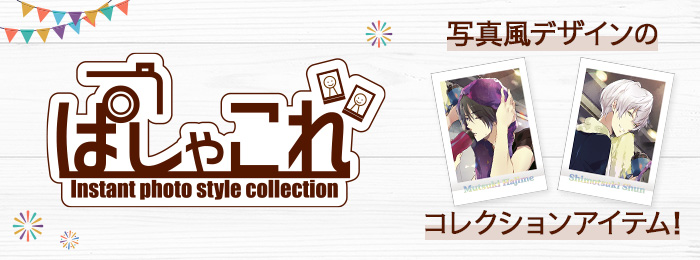
Image source: the Movic online shop's ぱしゃこれ brand page (movic.jp), captured on November 18, 2026, and used only to introduce a product discussed in this article.
## Mechanism 1: Random packs, a box designed not to complete
Take Movic's ぱしゃこれ as an example. Movic is the merchandise maker of the Animate group, and ぱしゃこれ is a character card made to look like an instant photo. For IDOLiSH7 volume 17, scheduled for release around November 27, 2026, the product page says:
- Types: 32 in all, plus 16 foil-signature versions (same artwork as the regular version, counted as a separate type).
- Per pack: 3 cards randomly drawn from all types.
- Per box: 10 packs at ¥2,750 (tax included), sold only by the box.
- The product page itself states: 「1BOX で全種類揃いません」 (one box does not give you every type).
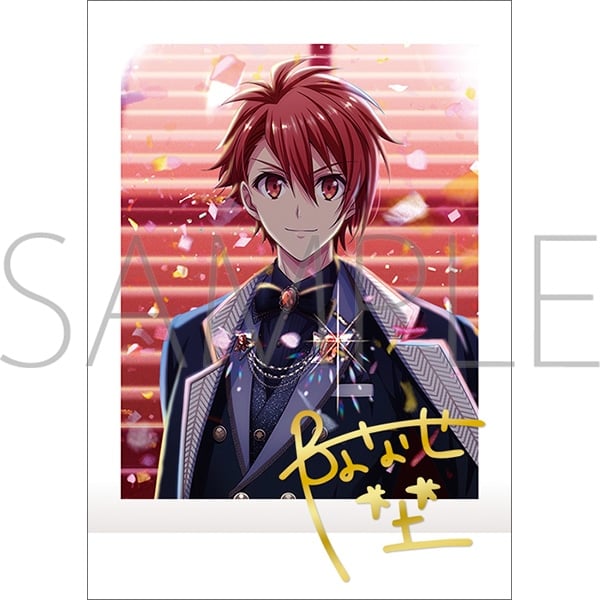
Image source: the Movic online shop's アイドリッシュセブン ぱしゃこれ volume 17 product page (movic.jp), captured on November 18, 2026, and used only to introduce a product discussed in this article; the SAMPLE mark on the image belongs to the original.
A quick calculation shows why the set cannot be completed:
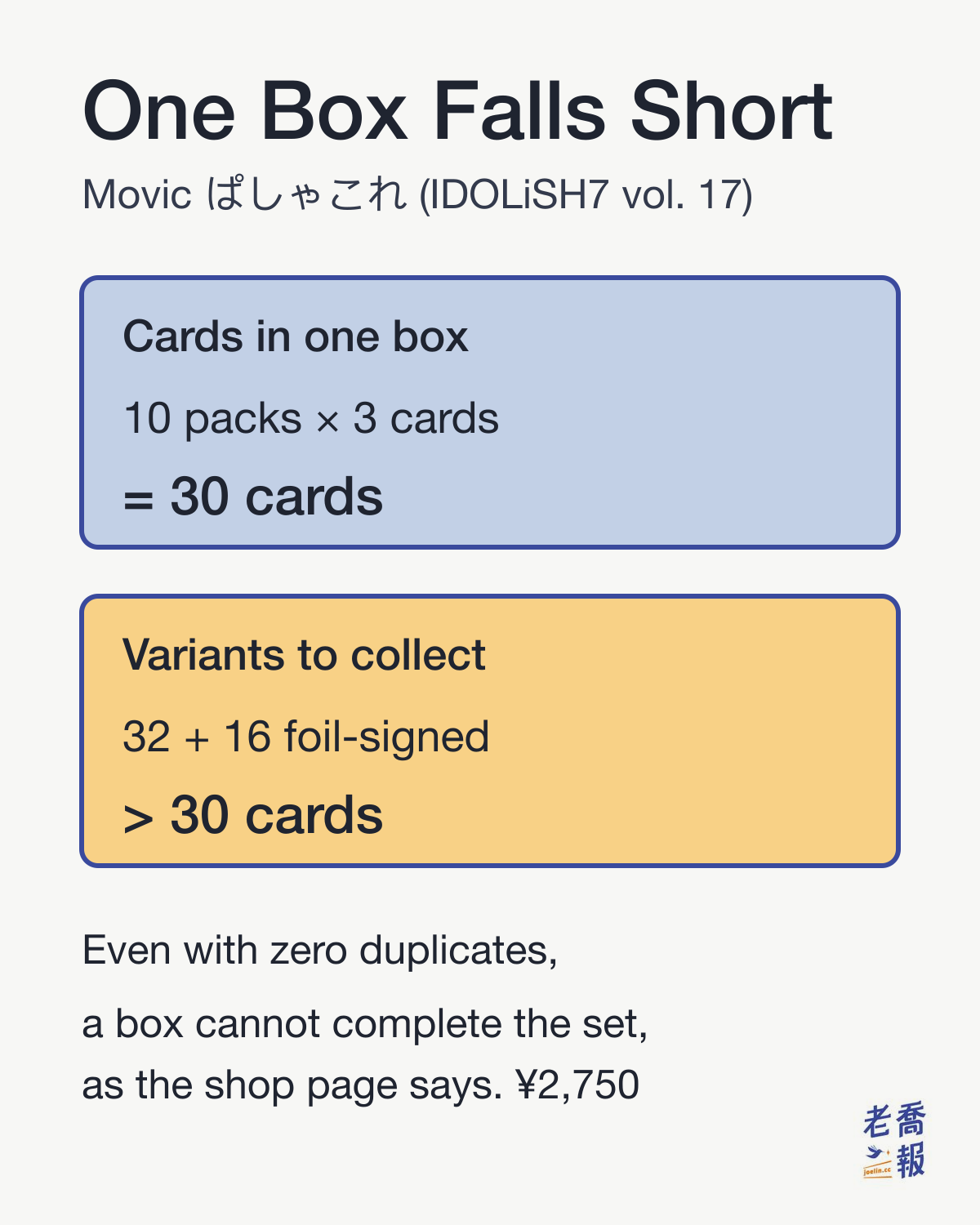
Image source: created by this site, based on the Movic online shop's product page (November 18, 2026).
A box has fewer cards than types, so even if you were lucky enough to get no duplicates at all, some types would still be missing. A customer who supports one character often wants only one or two of the cards, and the rest become something to deal with. That gap is the starting point for the next two mechanisms.
Candy toys use the same mechanism. Bandai's 「暁のヨナ」 wafers (released November 2, 2026) include 1 card each, 34 types in all, at ¥176 (tax included), with the target age labeled 「15 才以上」 (15 and up): the packaging is in snack food, but it is not positioned as a children's candy toy.
### The legal boundary: random sales are allowed, "collect the set for a prize" is not
A notice under Japan's Act against Unjustifiable Premiums and Misleading Representations covers exactly this. Item 5 of Fair Trade Commission Notice No. 3 of 1977 bans "カード合わせ" (card matching): making customers collect a specific combination of different types to exchange for a prize, banned regardless of the prize's value. The Consumer Affairs Agency's 2012 explanation says the reason is that the method is highly deceptive in itself, and is often used on children's products, over-stimulating the urge to gamble.
The same explanation also says that what you draw from a paid gacha is not itself a premium and is not subject to premium rules. That explanation concerns online games' コンプガチャ (complete gacha), but it states that the same mechanism is covered when it goes by another name; on that basis this site extends it to physical collectible cards: random-pack collectible cards can be sold, and what cannot be done is "send in a complete set to exchange for a limited item." Product pages today say "N types, random, one box cannot complete it," which states the number of types and the fact that one box cannot complete the set up front, rather than setting up a separate prize available only to those who complete it (the product pages do not publish the odds of each type).
## Mechanism 2: Trading, an outlet for duplicates
Random packs always produce duplicates. This site's view is that if duplicates can only be kept, customers stop quickly, and that they are more willing to open another pack if they can trade. Trading usually happens between customers, for example online, outside event venues and at fan meetups.
Event organizers do not always provide a place for trading, and some explicitly restrict it. Take AnimeJapan in 2026, whose official FAQ and merchandise page say:
- There is no trading area; people sitting down to trade inside the venue who affect others will be asked to stop or move.
- Cash transactions and resale are banned outright; transfers for profit, above the sale price, or to an unspecified number of people on auction sites and social media are all banned.
- The organizer's official merchandise shop has its own purchase limits (merchandise page): at most 3 items per product per checkout, and at most 22 random items per group.
This site's reading is that purchase limits and the resale ban address the same thing, which is to keep popular random items from being bought up in bulk and resold at high prices; what the rules ban is cash transactions and resale, and trading itself is not banned, just not given space.
## Mechanism 3: Event and purchase bonuses, a reason to buy again at a set time
The third mechanism is "spend a certain amount, or meet a certain condition, and get a card that is not in the box."
- Purchase bonus: at the Movic online shop's 「新テニスの王子様」 fair (November 21 to December 13, 2026), one illustration card for every ¥2,200 (tax included) spent, 11 types, not selectable, duplicates possible, while supplies last.
- Meal bonus: during an animate cafe collaboration period, one bonus comes with each dish ordered, and the type cannot be chosen; the event page also states that blind-draw (trading) merchandise may give you the same item twice.
Bonuses tie "random" to "period": the card can only be had in those few weeks at that place, so to get a particular one you must buy several times within the period. Bonuses are not priced separately (this site's inference is that the cost is spread into the original product or dish); for the customer, they are another set that cannot be completed, apart from the boxed collectible cards.
```mermaid
flowchart TD
A[Random packs
one box can't complete] --> B[Duplicate cards]
B --> C[Trading
swap for the one you want]
A --> D[Missing cards]
D --> E[Buy another box]
D --> C
F[Event and purchase bonuses
limited time, no choice] --> D
```
Image source: created by this site, compiled from the three mechanisms in this article.
## The numbers: makers do not disclose, and there is no market size
Almost no company figures for this business can be found.
The table shows what each company discloses.
| Company | Role | Disclosed |
|---|---|---|
| Movic | Merchandise maker | Capital only |
| Ensky | Merchandise maker | Capital only |
| Bushiroad MD | Merchandise division | Revenue, no cards |
| Bandai Namco | Candy toys | Not broken out |
The merchandise makers that produce random collectible cards are mostly unlisted, and their websites list only capital (Movic ¥10 million, Ensky ¥20 million); the earnings-notice aggregator for the official gazette (catr.jp) has no filings from them either. The closest listed company is Bushiroad's MD division (Bushiroad Creative), with ¥9.144 billion in revenue in FY6/2026, but its published product categories are figures, capsule toys and boxed toys, concert merchandise, character goods, prizes and other, with no "cards"; Bandai Namco's earnings presentation says that "cards, capsule toys and confectionery" sold well (the cards here mean battle cards), and candy toys have no separate figure. So "how much do oshikatsu collectible cards sell in a year" has no answer at present.
Market size is the same. The Japan Toy Association's card category statistic for FY2025 is an estimated ¥338.4 billion, but it says only "card games and trading cards" and does not say whether it includes merchandise makers' collectible cards and candy-toy cards; Yano Research Institute's "otaku market" survey has no collectible card category, and its "character business" figure is only the overall ¥2.8767 trillion (FY2025 estimate, merchandising and copyright).
## Compared with battle cards
The table compares battle cards with oshikatsu collectible cards.
| | Battle | Collectible |
|---|---|---|
| Why buy | Decks, tournaments | Pull your favorite, complete set |
| Random | Yes | Yes |
| Trading | Single-card shops | Between customers |
| Maker | Card companies | Merchandise, candy-toy makers |
| Public figures | Companies report | Almost none |
Both kinds of card use random packs to make people buy more; the difference is where duplicates go. Battle cards have single-card shops and secondhand platforms that buy them, which forms a price; the main outlet for oshikatsu collectible cards is trading between customers, and at AnimeJapan, for example, the organizer explicitly bans resale. Another difference is transparency: for battle cards there are companies like Bushiroad that publish TCG revenue, while oshikatsu collectible cards are hidden inside merchandise and snacks, with no primary figure even for market size.
## Where to buy in Japan
Oshikatsu collectible cards are mainly bought at anime-merchandise shops such as Animate, makers' official online shops, collaboration cafes and event venues; snack-with-card products are sold in supermarkets and convenience stores. Battle cards and some collectible cards can also be found at specialist card shops, and you can look them up with the [Japan card shop directory](https://gacha.joelin.cc/en/card/) that Joe Lin (老喬) runs: 16 chains and major independent shops (November 2026).
## FAQ
### Why can't you complete a set from one box of random oshikatsu cards?
Because there are more card types than cards in a box. Take Movic's ぱしゃこれ (instant-photo-style cards), IDOLiSH7 volume 17: a box holds 10 packs of 3 cards, 30 cards in all, but there are 32 types plus 16 foil-signature types. Even with zero duplicates you cannot finish, and the product page itself says "1BOX で全種類揃いません" (one box does not give you every type). The rest has to come from buying more, trading with other people, or purchase bonuses.
### Are random-pack collectible cards legal in Japan?
Selling them at random is legal. The notice under Japan's Act against Unjustifiable Premiums and Misleading Representations (景品表示法) bans "カード合わせ" (card matching): making customers collect a specific combination to exchange for a prize, banned outright regardless of the amount. The Consumer Affairs Agency's explanation is that what you get from a paid gacha is not itself a premium and is not subject to premium rules. That explanation is about online games' コンプガチャ (complete gacha); this site extends it to physical cards: selling random cards is fine, but running a "collect the full set for a grand prize" campaign is not.
### How much do Japanese anime-merchandise makers earn from collectible cards?
It cannot be found. Movic and Ensky, which make random collectible cards, are not listed; their websites show only capital, and the earnings-notice aggregator for Japan's official gazette has no filings from them. Among listed companies, Bushiroad's merchandise division had ¥9.144 billion in revenue in FY6/2026, but its product categories do not include cards, and Bandai Namco does not break out candy-toy sales either.
### Can you trade collectible cards at an event venue?
It depends on the event. At AnimeJapan 2026, the organizer provides no trading area, asks people to stop or move if trading affects others, and bans all cash transactions and resale; in the organizer's own official merchandise shop, random items are limited to 22 per group. Check the event's FAQ before you go.
## Related reading
- [Japan trading card industry research series guide](/en/p/10127): the full table of contents, key figures from each article and how the figures are defined
- [The six kinds of women's card customers](/en/p/10118): oshikatsu collectible cards belong to the "anime and game oshi" group
- [How girls' arcade cards make money](/en/p/10165): also driven by "which card comes next," but the card doubles as the game's save file
- [Bushiroad's sister brand Weiß Schwarz Blau ended after four years](/en/p/10163): one attempt to bring battle cards to the oshi-work audience
Sources: Movic ぱしゃこれ IDOLiSH7 volume 17 product page, ぱしゃこれ brand page, 新テニスの王子様 fair, company profile; Bandai 暁のヨナ カードウエハース product page; animate cafe event page; AnimeJapan 2026 FAQ, AnimeJapan 2026 merchandise page; Consumer Affairs Agency notice on limits on prize offers, コンプガチャと景品規制 (2012-05-18, partly revised 2016); Ensky company profile; Bushiroad earnings presentation for FY6/2026; Bandai Namco earnings presentation for FY3/2026; Japan Toy Association domestic toy market size; Yano Research Institute otaku market survey, character business market survey. Checked on November 18, 2026. The infographic and the lead image were created by this site; the product images come from official online shops and are used only to introduce products. This article is industry research and is not investment advice, and it does not discuss card prices or resale.
Keywords: 推し活 トレカ, oshikatsu collectible cards, ランダム トレカ 揃わない, カード合わせ 景品表示法, ぱしゃこれ, Movic, ランダムグッズ, purchase bonuses
Sources: The Chinese original was first published on 2026-11-18 (Taipei date). Figures and dates are as of the sources checked on 2026-11-18. The subject is Japan; the note on supermarkets and convenience stores refers to Japan, and any Taiwan translations of titles apply to Taiwan only.
AI-assisted translation and editing: Caddy (AI)
[Original article](/p/10166)